

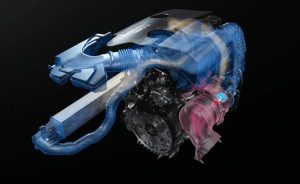
 Reflecting the importance of the Altima to the Nissan brand, the company is making its largest investment ever in a new model powertrain development – introducing for the first time, two completely new engines for one model change.
The new 2.0-liter VC-Turbo, which recently launched as a world’s first technology in the all-new INFINITI QX50 crossover, replaces the previous-generation Altima’s 3.5-liter V6, offering similar performance figures while providing 4-cylinder fuel economy. It will be available on the Altima SR and Platinum front-wheel drive grades.
The new 2.5-liter inline 4-cylinder, which is standard on all 2019 Altima front-wheel drive and Intelligent All-Wheel Drive grade levels, utilizes more than 80% new or redesigned parts. It offers 9 additional horsepower and a fuel economy improvement versus the previous-generation 2.5-liter design.
Importantly, both engines’ short profile designs and low engine mountings contribute to the all-new Altima’s low and wide exterior design, including the lower hood and cowl – as well as reduced levels of noise, vibration and harshness (NVH).
“With its long list of Nissan Intelligent Mobility features such as ProPILOT Assist, this all-new 2019 Altima is the most advanced sedan we have ever built,” said José Muñoz, chief performance officer, Nissan Motor Co., Ltd. “Yet not to be overlooked is the groundbreaking technology under the hood – two new engines that power the Altima’s balanced, confidence-inspiring driving experience.”
World’s first production Variable Compression Turbo engine
Designated as the VC-Turbo, the technology behind the new Altima powerplant was more than 20 years in development and represents a breakthrough in combustion engine design by continually adjusting its compression ratio to optimize power and fuel efficiency. It is projected to offer a double-digit percentage increase in fuel economy.
Assembled in Japan, the VC-Turbo changes its compression ratio seamlessly through an advanced multi-link system, continuously raising or lowering the pistons’ reach to transform compression ratio – offering both power and efficiency on demand. A high compression ratio gives greater efficiency, but in certain applications poses the risk of premature combustion (knocking). A low compression ratio allows for greater power and torque and avoids knocking.
Connect with us


Recent Blog Entries
- Passport Nissan MD’s Guide to Maintaining Your Nissan
- Mastering the Art of Remote Start: A Comprehensive Guide from Passport Nissan MD
- Mastering Voice Commands in Your Nissan – Unlocking the Power of Hands-Free Control
- Why buy Nissan Certified Pre-Owned from Passport Nissan MD
- Routine Maintenance from Passport Nissan MD Keeps Your Vehicle Performing at Its Best